conditional_execution
Queries might require conditional execution logic that can’t be adequately
expressed in Cypher. The do module makes it possible to define complex logic
that will control query execution.
| Trait | Value |
|---|---|
| Module type | module |
| Implementation | C++ |
| Parallelism | sequential |
Procedures
The following procedures can’t be used to run queries that execute global operations:
- creating and deleting indexes
- creating and deleting constraints
- changing the global isolation level
- setting the storage mode
case()
When given a list of condition-query pairs, do.case executes the query associated
with the first condition evaluating to true (or the else query if none are
true) with the given parameters.
Parameters are prefixed with $ like $param_name. Check the documentation on
querying for examples.
Input:
conditionals: List[Any]➡ Variable-length list of condition-query pairs structured as[condition, query, condition, query, …]. Conditions arebooleanand queries arestring.else_query: string (default = "")➡ The query to be executed if no condition evaluates totrue.params: Map (default = NULL)➡ If any of the given queries is parameterized, provide a{param_name: param_value}map to be applied to them.
Output:
value: Map➡ Contains the result record of the executed query. Eachvaluecorresponds to one result record.
Usage:
The following example checks how many nodes there are in the database, and
returns empty if there are 0 nodes, one node if there is 1 node, or
multiple nodes if any other result is produced by the size(collect(n))
functions:
MATCH (n)
WITH size(collect(n)) as n_nodes
CALL do.case([n_nodes = 0,
              "RETURN 'empty' AS graph_status;",
              n_nodes = 1,
              "RETURN 'one node' AS graph_status;"],
              "RETURN 'multiple nodes' AS graph_status;")
YIELD value
RETURN value.graph_status AS graph_status;
when()
do.when evaluates the given condition and executes the if query or the
else query depending on whether the condition is satisfied.
Parameters are prefixed with $ like
$param_name.
Input:
condition: boolean➡ Determines what query to execute.if_query: string➡ The query to be executed if the condition is satisfied.else_query: string (default = "")➡ The query to be executed if the condition isn’t satisfied.params: Map (default = NULL)➡ Ifif_queryorelse_queryare parameterized, provide a{param_name: param_value}map to be applied.
Output:
value: Map➡ Contains the result record of the executed query. Eachvaluecorresponds to one result record.
Usage:
The following example checks how many nodes there are in the database, checks if
the result is 0, and returns empty if is, and not empty if it isn’t:
MATCH (n)
WITH size(collect(n)) as n_nodes
CALL do.when(n_nodes = 0,
             "RETURN 'empty' AS graph_status;",
             "RETURN 'not empty' as graph_status;")
YIELD value
RETURN value.graph_status AS graph_status;
Example
Database state
The database contains the following data:
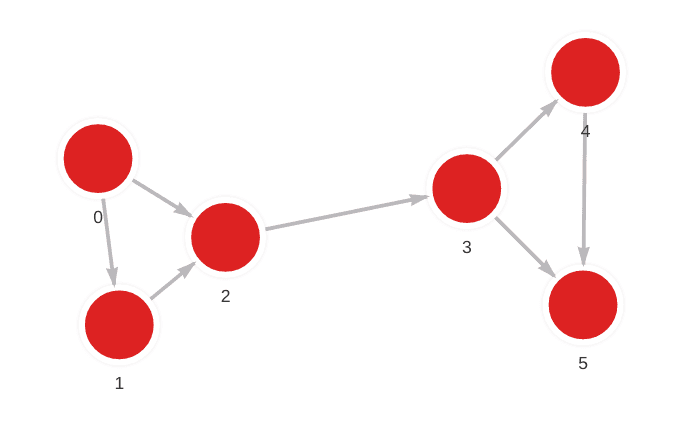
Created with the following Cypher queries:
MERGE (a:Node {id: 0}) MERGE (b:Node {id: 1}) CREATE (a)-[:RELATION]->(b);
MERGE (a:Node {id: 1}) MERGE (b:Node {id: 2}) CREATE (a)-[:RELATION]->(b);
MERGE (a:Node {id: 0}) MERGE (b:Node {id: 2}) CREATE (a)-[:RELATION]->(b);
MERGE (a:Node {id: 3}) MERGE (b:Node {id: 4}) CREATE (a)-[:RELATION]->(b);
MERGE (a:Node {id: 3}) MERGE (b:Node {id: 5}) CREATE (a)-[:RELATION]->(b);
MERGE (a:Node {id: 4}) MERGE (b:Node {id: 5}) CREATE (a)-[:RELATION]->(b);
Check a condition
Check if the number of nodes is equal to 0, and return appropriate message:
MATCH (n:Node)
WITH size(collect(n)) as n_nodes
CALL do.when(n_nodes = 0,
             "RETURN 'empty' AS graph_status;",
             "RETURN 'not empty' as graph_status;")
YIELD value
RETURN value.graph_status AS graph_status;
Result:
┌──────────────┐
│ graph_status │
├──────────────┤
│ not empty    │
└──────────────┘